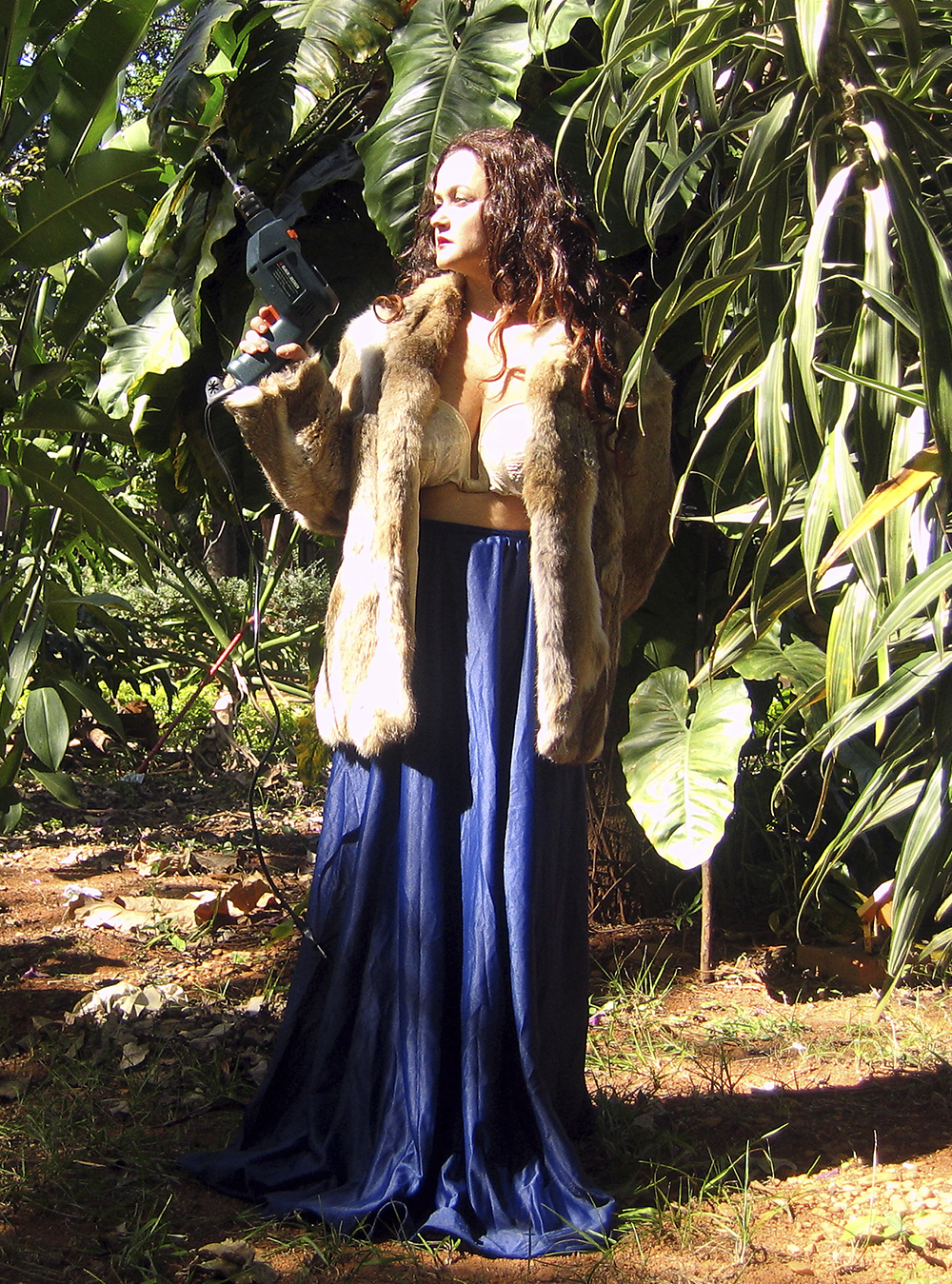
In 2011, I was invited by Laura to create and direct a video with her. Her background is in dance, with a strong interest in literature and feminism, and although we had already worked together in Brazil (she has performed in some of my installations) this time it was a completely new universe to me, to co-create a performance piece for video as part of her residence in screen dance in London.
Although she had some ideas about what she wanted the video to be about, it didn’t take long to convince her that as Brazilians living in London, we should take advantage of it, and use the city as the leitmotif of our video. Having never been in London before, Laura told me that her fantasy of what London was like was related to a book she had read as a teenager, A Room of One’s Own, by Virginia Woolf, which made an enormous impression in her as an young female artist. In turn, I told her that to me London had become intrinsically associated to its museums and art galleries. Our departure point was so to explore London museums and Virginia Woolf’s literary universe.
The book ‘A Room of One’s Own’ is actually an extended essay based on a series of lectures Virginia Woolf delivered in 1928, under the title of ‘Women and Fiction’. In it, she arrives to the conclusion that if women wanted to be writers they needed to achieve the same material independence as men.
As an important part of the essay was set in the British Museum, I decided to organize a ‘literary’ tour for us in Bloomsbury. We spent two days in the area, mapping all the places where VW lived and worked and trying to imagine the cultural significance of the Bloomsbury group and the role of the British Museum in the early 1900’s. At the end, we were so enthused by Bloomsbury that we decided to set our video there. We wanted to match up its architecture and squares with something surreal, a mish-mash of Englishness, art history, feminism, theatricality and carnival
Scenes were named according to each location: Church (an early English neo-gothic Church of Christ the King, in Gordon Square, where we filmed the first scene). Museum (the British Museum, at the centre of Bloomsbury; Virginia Woolf used to work daily in its Reading Room). Hotel (The Montague on The Gardens, a luxurious Georgian hotel, opposite the British Museum). Street (Gordon Square, a street where many members of the Bloomsbury group, including Virginia Woolf, either lived or worked). Garden (Gordon Square’s central garden, originally private, for the sole use of the residents).
We inserted some (tropicalista) feminist statements in the video:
• Coloured self-adhesive vinyl spots (leftovers from the installation Play Back) were stuck in every location we filmed. We used the spots as a demarcation of territory and a metaphor for women’s emergence into the public artistic arena
• Laura’s stylised Carmen Miranda was a homage to Brazilian culture, to dance, and to women artists of the 20th century (by some accounts, the Portuguese-Brazilian singer Carmen Miranda was the highest-earning woman in the United States, in the 1940s)
• The Golden-Frog, an sculpture from my installation In Pieces, was used in the internal scenes at the hotel bedroom, when Laura appears reading VW book.
The project took from early February to August 2011, with many breaks due to our busy timetables. The actual filming happened in May when we moved temporarily to Bloomsbury for five days, a period during which we did all the filming. There was no script and I learned how to use the video camera on the spot (Laura bought it at Tottenham Court Rd and we both learned the basics by reading the manual and by trial and error). During the editing we decided to have a voiceover. The quotes, extracted from VW essay, added a narrative structure and provided the musicality of Virginia’s prose. The video was launched by Laura in Brazil, on 26th of November 2011, in a Screen Dance Festival at the University of Brasilia.
Initially, I was concerned the video could end up as a digression, with not much connection to what I was doing at the doctorate. I have been focused in installation and making a video ,a medium I had not much curiosity about, could be a recipe for disaster. Surprisingly, I was very excited with the results.
One of the key arguments of Graham Coulter-Smith, in Deconstructing Installation Art, is that because of its narrative dimension, installation art is more connected with video art (and media art, in general) than with sculpture (installation art was primarily referred as gallery-bound expanded sculpture, as described by Rosalind Krauss in her essay ‘Sculpture in an Expanded Field’, from 1979)
I have shown the video recently in a video- installation where I inserted a mask on top of the images to create a round frame. I had some furniture in the room (a round mirror and two twins dressing tables) plus my Golden-Frog sculpture and the vinyl spots we used in the video making.
Notes about the video and the installation:
• The methodology behind the video was similar to the one behind making sculptures or painting: clumsy imitation, superficial technical knowledge, happy chance and ‘ making = playing’.
• How could I transform a video in an installation piece? I would have to treat it as an object, definitely.
• Thinking about the video as an ‘object’ made it easier to start reasoning in terms of ‘actions’, so simple as ‘move it around, no, yes, there, a little bit more to the right, and so on… I felt no constrains about ‘cutting’ half of each image with the round frame.
• I am interested in putting ‘objects’ to talk to each other, but the mirror and tables were thought originally as an attempt to solve an spatial problem. As the projection was on the wall adjacent to the entrance, I wanted the audience to be able to see it from the door. Although it didn’t work that way, the mirror and dressing tables referenced to scenes in the video (in the hotel) and were evocative of art history subjects (portrait, the picture inside the picture, etc.) and of ‘the feminine’.
• Process is about finding connections between things. Sometimes the result can be complex sometimes very simple and direct. But it is pure contingency
.